
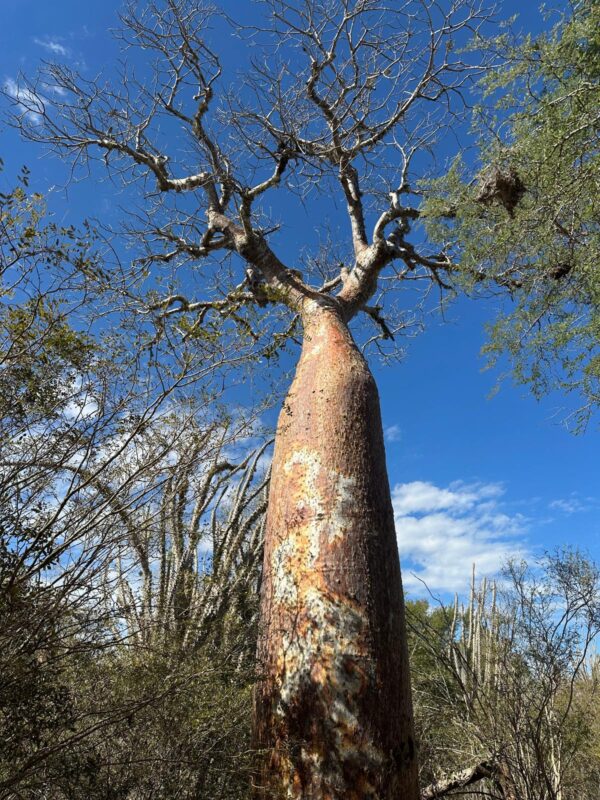
Over the years, Dr. Laz Priegues has shared his tropical travelogues with fellow members of the South Florida Palm Society. At the April general meeting of the SFPS, he presented Part I of his three-week trip to Madagascar. Three weeks probably sounds like a long time, but then Madagascar is the fourth largest island in the world — and the largest in Africa — so there’s a lot to see.
At the October meeting, Part II of Laz’s travelogue entertained and enlightened an appreciative crowd. This time he and fellow risk-taker Gloria Batule took on the challenges of the Spiny Forest and the Stone Forest.
Their first stop, the Spiny Forest in southwest Madagascar, is vast — some 17,000 square MILES. It contains not only interesting animals, including lemurs, sefakas, butterflies, birds, and tortoises, but also a tremendous array of plants in a region where the rainy season is brief. In fact, about 95% of the flora there are endemic.
But for all the spiny plants in this forest, it is the baobab, a spineless genus, that often dominates the harsh landscape. The trees are large, oddly-shaped, long-lived, and capable of storing huge quantities of water in their spongy trunks. (Although they’re drought-tolerant, baobabs are not totally immune to long-term drought. In mainland Africa, in the last dozen or so years, several of the most ancient baobabs — 1,000 to 2,500 years old — have suddenly collapsed. Experts attribute this botanical disaster to a combination of severe drought and excessive heat brought on by climate change.)
The more dangerous part of the Priegues-Batule expedition came in northwest Madagascar in the Stone Forest, a UNESCO-designated World Heritage Site since 1990. The region, comprising some 580 square miles, is locally known as Tsingy, a word in the Malagasy language which is often translated as “where one cannot walk barefoot.” That’s a major understatement. The Stone Forest’s razor-sharp limestone formations can cut you up worse than a Saturday night gang fight. Missteps on the park’s ladders or swinging wooden suspension bridges can result in catastrophic falls.
Fortunately, the fabulous island isn’t constantly fraught with danger. Along the way, our travelers were also able to enjoy delicious meals and hotels with memorable views.
Take a look at the sights of Madagascar that Laz shared with the audience, and then plan to join us sometime in 2027 for Part III of the adventure.
See more images on the Facebook page Click here
Leave a Reply